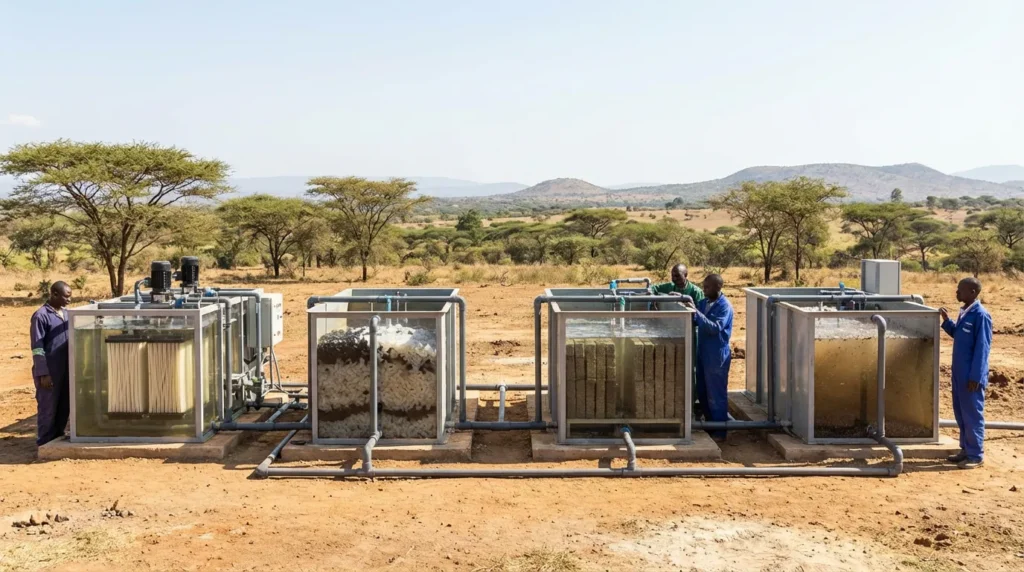
MBR vs MBBR vs SAFF vs FAB for Kenya: Which STP/ETP Technology Fits Your Site, Power Costs, and Compliance Targets?
Kenya faces rising pressure on water resources, land, and energy. Choosing the right sewage or effluent treatment system now decides your operating cost for the next 15–20 years. This guide explains MBR vs MBBR vs SAFF vs FAB for Kenya in simple language. It helps factory managers, municipal engineers, and developers compare space needs, electricity bills, and NEMA compliance risks before making a decision.
Why Kenya Needs Smarter Wastewater Treatment in 2025
Kenya’s cities grow faster than sewer networks. Nairobi alone adds thousands of new connections every year. Industries in Thika, Athi River, and Mombasa discharge more complex effluent. At the same time, water scarcity pushes reuse for flushing, cooling, and landscaping.
NEMA enforcement has become stricter. Closure notices now come with short deadlines. Power tariffs from Kenya Power stay high, averaging KES 24 per kWh. Land prices in urban zones keep rising. These pressures force decision-makers to pick STP technology Kenya can sustain, not just install.
The Four Main STP & ETP Technologies Explained for Non-Engineers
A Practical Guide from a Kenyan Wastewater Specialist
Choosing the right Sewage Treatment Plant (STP) or Effluent Treatment Plant (ETP) technology is critical for regulatory compliance, operating cost, and long-term reliability. In Kenya, factors such as land availability, power stability, skill levels, and water reuse needs strongly influence technology selection.
Below is a simple, non-technical explanation of the four most commonly used wastewater treatment technologies in Kenya: MBR, MBBR, SAFF, and FAB.
1. What is MBR (Membrane Bioreactor)?
MBR (Membrane Bioreactor) combines biological treatment with membrane filtration in a single system.
You can think of it like a coffee filter:
- Bacteria break down organic waste in the wastewater.
- A fine membrane allows only clean water to pass through.
- All solids, sludge, and most germs are blocked.
Key Benefits of MBR
- Produces very high-quality effluent
- Water is suitable for reuse (toilet flushing, landscaping, cooling towers)
- Requires much less land than conventional treatment systems
Challenges
- Membranes require regular cleaning
- Needs continuous and stable power
- Higher capital and operating costs
Where MBR Works Best in Kenya
MBR systems are ideal for:
- Nairobi and other urban areas with limited space
- Hotels, hospitals, malls, and high-end residential developments
- Projects where water reuse is a priority
2. What is MBBR (Moving Bed Biofilm Reactor)?
MBBR (Moving Bed Biofilm Reactor) uses thousands of small plastic carrier media that float freely inside an aeration tank.
Imagine tiny sponges moving around in water:
- Beneficial bacteria grow on the surface of the carriers
- Air keeps the media in constant motion
- More bacteria = more treatment capacity without large tanks
Key Benefits of MBBR
- Handles fluctuating wastewater loads very well
- Requires simpler operation than MBR
- Lower energy and maintenance needs
- Modular and easy to upgrade
Why MBBR is Popular in Kenya
Many ETP and STP projects in Kenya prefer MBBR because it offers:
- A balanced cost-to-performance ratio
- Reliability for commercial and industrial sites
- Flexibility for expanding towns and industrial parks
3. What is SAFF (Submerged Aerated Fixed Film)?
SAFF (Submerged Aerated Fixed Film) systems use fixed plastic media blocks installed inside aeration tanks.
Think of it like a brush in flowing water:
- Bacteria attach themselves to the fixed media
- Wastewater flows past while bacteria remove pollutants
- Media does not move, making the system simple and stable
Key Benefits of SAFF
- Lower power consumption compared to MBR and MBBR
- More tolerant to power interruptions
- Simple operation with minimal automation
- Easy maintenance
Ideal Applications in Kenya
SAFF systems are widely used in:
- Upcountry towns
- Schools, hospitals, and institutions
- Areas with limited skilled labour
- Locations with unstable electricity supply
4. What is FAB (Fluidised Aerobic Bioreactor)?
FAB (Fluidised Aerobic Bioreactor) uses lightweight media that stays suspended in water with the help of air.
Picture sand swirling in water:
- Media is continuously moving
- Bacteria grow on the moving surface
- High contact between bacteria and wastewater ensures fast treatment
Key Benefits of FAB
- Excellent for high-strength industrial wastewater
- Requires less land than SAFF
- High treatment efficiency for organic loads
Typical Use in Kenya
FAB technology is commonly applied in:
- Food and beverage industries
- Breweries and dairies
- Agro-processing plants
- Industrial effluent treatment solutions
Side-by-Side Comparison Table
| Technology | Space Needed (m² per 100 m³/day) | Power Consumption (kWh/m³) | Maintenance Skill Level | Typical Cost (KES per m³/day capacity) | Best For | NEMA Compliance Ease |
| MBR | 35–45 | 1.2–1.5 | High | 140,000–180,000 | Urban sites, reuse | Very Easy |
| MBBR | 60–75 | 0.8–1.0 | Medium | 90,000–120,000 | Mixed industrial loads | Easy |
| SAFF | 80–100 | 0.5–0.7 | Low | 70,000–95,000 | Low power areas | Moderate |
| FAB | 55–65 | 0.7–0.9 | Medium | 85,000–110,000 | High BOD industries | Easy |
How to Choose Based on Your Kenya Site Conditions
If You Have Limited Land (Urban Nairobi/Mombasa)
Land in industrial Nairobi can exceed KES 25 million per acre. Space matters. MBR uses the smallest footprint. FAB and MBBR come next. SAFF needs the most area.
If your site sits in Westlands, Upper Hill, or Nyali, compact systems reduce civil costs and approval delays.
If Electricity Costs Are Your Biggest Worry
Power bills hurt margins. SAFF uses the least energy. FAB follows. MBBR sits in the middle. MBR uses the most power due to membranes and continuous aeration.
Sites facing frequent power rationing in upcountry counties benefit from SAFF with standby blowers.
If You Lack Skilled Technicians
MBR needs trained operators for membrane care. MBBR and FAB need basic mechanical skills. SAFF works with minimal training.
For facilities outside Nairobi, simpler systems reduce downtime and dependence on specialist visits.
If You Need Fast NEMA Approval
NEMA focuses on final effluent quality. MBR meets limits easily. MBBR and FAB also pass with good design. SAFF may need polishing units.
If deadlines are tight, technologies with predictable output reduce compliance risk.
Real Kenya Wastewater Treatment Success Stories
Across Kenya, industries and commercial developments are increasingly investing in efficient wastewater treatment plants (ETPs and STPs) to meet NEMA discharge standards, control power costs, and improve sustainability. The following real-world case studies from Kiambu County and Kisumu County demonstrate how the right technology choice delivers measurable results.
Case Study 1: GreenSpun Textiles Ltd – Thika, Kiambu County
Client Profile and Location
GreenSpun Textiles Ltd is a mid-sized textile manufacturing factory located in Thika, Kiambu County, a region with strict regulatory oversight due to industrial density and proximity to water bodies.
Operational Challenge
The factory was generating approximately 350 m³/day of industrial wastewater with:
- BOD levels at 280 mg/L, exceeding NEMA allowable discharge limits
- High energy consumption, with a monthly power bill of KES 180,000
- Increasing compliance pressure and risk of regulatory penalties
The client required a reliable, low-energy solution that could handle variable textile effluent loads without complex operation.
Implemented Solution
A Moving Bed Biofilm Reactor (MBBR)–based Effluent Treatment Plant (ETP) was designed and installed with a capacity of 400 m³/day, allowing for future expansion.
The treatment system included:
- Inlet screening and equalisation tank
- MBBR biological reactors
- Tube settler clarifier
- Sand filtration for final polishing
Project Timeline
- Design to commissioning: 6 months
Performance Results
Post-commissioning performance showed immediate and sustained improvement:
- BOD reduced from 280 mg/L to 25 mg/L
- COD reduced from 620 mg/L to 80 mg/L
- Monthly power cost reduced by KES 45,000
- Full NEMA compliance achieved in March 2024
Client Feedback
“We stabilised compliance and cut energy costs without complex operation.”
— Factory Manager, GreenSpun Textiles Ltd
Specialist Insight
For textile industries in Kenya, MBBR technology offers an optimal balance between treatment efficiency, operational simplicity, and electricity cost control, making it ideal for long-term compliance.
Case Study 2: Lakeview Commercial Complex – Kisumu County
Client Profile and Location
Lakeview Commercial Complex is a large mixed-use development located in Kisumu County, serving offices, retail outlets, and residential users within a constrained urban footprint.
Operational Challenge
The facility was handling approximately 500 m³/day of domestic sewage, with key challenges including:
- Severe space limitations
- Persistent odour complaints from occupants
- Failure to meet Total Suspended Solids (TSS) discharge limits
- Rising water utility costs
Implemented Solution
A Membrane Bioreactor (MBR)–based Sewage Treatment Plant (STP) was installed with a design capacity of 550 m³/day, ensuring regulatory compliance and reuse capability.
The system comprised:
- Fine screening at inlet
- MBR biological and membrane tanks
- UV disinfection for safe reuse and discharge
Project Timeline
- Total duration: 7 months, including statutory approvals
Performance Results
The MBR system delivered high-quality effluent suitable for reuse:
- BOD reduced from 210 mg/L to 10 mg/L
- TSS reduced from 180 mg/L to <5 mg/L
- 40% of treated water reused for toilet flushing
- NEMA approval granted in July 2024
Before and After Impact
- Before: Dark, turbid effluent with noticeable odour and open treatment units
- After: Clear, odour-free water, enclosed tanks, and a landscaped green buffer zone
Client Feedback
“Water reuse cut our utility bills by nearly 40%.”
— Property Engineer, Lakeview Commercial Complex
Specialist Insight
In space-constrained urban developments in Kenya, MBR systems provide superior effluent quality and water reuse potential, justifying higher energy use through long-term utility savings.
Power Costs Breakdown: What You’ll Actually Pay for Wastewater Treatment in Kenya
Electricity cost is one of the largest operational expenses in wastewater treatment plants in Kenya. With Kenya Power’s average industrial tariff at approximately KES 24 per kWh, understanding real power consumption is critical when selecting the right treatment technology.
The analysis below reflects typical monthly electricity costs for a 300 m³/day wastewater treatment system, based on real operating data from Kenyan industrial and municipal installations.
Understanding Energy Consumption in Kenyan Wastewater Systems
In Kenya, wastewater treatment plants operate continuously, often 24/7, making energy efficiency a key determinant of long-term OPEX. Aeration systems, blowers, and recirculation pumps are the main power consumers, and their efficiency varies significantly by process type.
MBR Power Consumption Reality (Membrane Bioreactor)
- Specific energy consumption: ~1.3 kWh/m³
- Monthly power cost: ≈ KES 280,000
MBR systems are the most energy-intensive among conventional aerobic technologies. The high power demand is driven by:
- Continuous membrane air scouring
- Higher blower pressures
- Intensive recirculation requirements
In the Kenyan context, MBRs are best justified where treated effluent reuse offsets water bills, such as in commercial buildings, gated communities, hospitals, and water-scarce industrial zones. Without reuse, power costs can significantly impact operating budgets.
MBBR Power Consumption Reality (Moving Bed Biofilm Reactor)
- Specific energy consumption: ~0.9 kWh/m³
- Monthly power cost: ≈ KES 195,000
MBBR offers a balanced and cost-effective solution for most Kenyan industries. Its moderate energy demand results from:
- Efficient oxygen transfer
- Reduced sludge handling
- Stable biological performance under load fluctuations
For food processing plants, beverage factories, and light manufacturing facilities, MBBR provides a strong balance between compliance, reliability, and electricity cost control.
SAFF Power Consumption Reality (Submerged Aerated Fixed Film)
- Specific energy consumption: ~0.6 kWh/m³
- Monthly power cost: ≈ KES 130,000
SAFF systems deliver the lowest power consumption among aerobic wastewater treatment technologies commonly used in Kenya. This efficiency is due to:
- Fixed media requiring less agitation
- Lower blower air demand
- Simple hydraulic design
SAFF is ideal for facilities prioritizing low operational costs, especially in regions where power supply is unstable or expensive. It is widely used in schools, institutions, residential estates, and small municipalities.
FAB Power Consumption Reality (Fluidized Aerobic Bed)
- Specific energy consumption: ~0.8 kWh/m³
- Monthly power cost: ≈ KES 175,000
FAB systems are optimized for high-strength industrial effluent, such as:
- Abattoirs
- Dairies
- Food and beverage plants
While energy use is slightly higher than SAFF, FAB delivers superior organic load handling and faster treatment kinetics, making it a practical choice where effluent strength—not just flow rate—is the limiting factor.
Key Takeaway for Kenyan Wastewater Projects
When designing or upgrading a wastewater treatment plant in Kenya, energy consumption directly translates into long-term operating cost. The cheapest CAPEX option is not always the most economical over time.
- MBR: Highest energy, best for reuse-driven projects
- MBBR: Balanced and versatile for most industries
- SAFF: Lowest power cost, ideal for OPEX-sensitive projects
- FAB: Efficient choice for high-strength wastewater
Selecting the right technology should always consider Kenya Power tariffs, effluent characteristics, reuse potential, and long-term operational sustainability.
NEMA Compliance and Effluent Standards for 2025
NEMA requires treated wastewater to meet limits such as:
- BOD (Biological Oxygen Demand) ≤ 30 mg/L
- COD (Chemical Oxygen Demand) ≤ 50–100 mg/L
- TSS (Total Suspended Solids) ≤ 30 mg/L
MBR meets these with ease. MBBR and FAB meet them with correct sizing. SAFF may need tertiary filtration for strict discharge zones.
Watertech Kenya 2026 – See These Technologies Live
Watertech Kenya 2026 – Water Technology Trade Exhibition brings suppliers and decision-makers together. Arnym Eco Green will exhibit working models.
Visitors can see live demos, touch media, and attend NEMA compliance workshops. Book a pre-show consultation to discuss your STP or ETP needs face-to-face.
Why Choose Arnym Eco Green for Your Wastewater Project
Proven Kenyan Wastewater Engineering Expertise
Arnym Eco Green brings deep, Kenya-specific wastewater treatment design and implementation experience, with successfully delivered projects across Nairobi, Mombasa, and Kisumu. These regions present diverse wastewater challenges—ranging from high-strength industrial effluent and saline coastal conditions to variable municipal influent loads. Arnym’s local engineering knowledge ensures systems are designed to perform reliably under Kenyan climatic, regulatory, and operational realities.
This practical, on-the-ground experience significantly reduces design risk and improves long-term plant performance.
End-to-End Post-Installation Support in Kenya
Unlike suppliers that disengage after commissioning, Arnym Eco Green maintains a strong post-installation support network across Kenya. This ensures rapid technical assistance, routine inspections, troubleshooting, and process optimisation long after handover.
Local presence translates to reduced downtime, faster response times, and continued compliance with discharge standards throughout the system’s lifecycle.
Full NEMA Documentation and Regulatory Support
Navigating environmental approvals in Kenya can be complex. Arnym Eco Green provides comprehensive NEMA documentation assistance, including environmental impact assessments (EIA), audit reports, effluent discharge compliance documentation, and liaison support.
This end-to-end regulatory support helps clients achieve timely approvals, maintain compliance, and avoid operational or legal disruptions.
Reliable Local Spare Parts Availability
Arnym Eco Green ensures readily available local spare parts, minimising reliance on imports and reducing lead times for critical components. This localised supply chain is essential for maintaining continuous plant operation, particularly in industrial and municipal facilities where downtime is costly.
Energy-Efficient and Customised Treatment Solutions
Energy costs are a major operational concern for wastewater treatment plants in Kenya. Arnym Eco Green designs energy-efficient, site-specific systems, optimised for influent characteristics, discharge requirements, and power availability.
Through equipment selection, process optimisation, and automation, systems are customised to reduce energy consumption while maintaining treatment efficiency.
Capacity Building and Operator Training Programs
Long-term wastewater plant performance depends on skilled operators. Arnym Eco Green offers structured training programs for local operators, covering routine operations, preventive maintenance, safety procedures, and regulatory compliance.
This approach supports skills transfer, reduces operator error, and enhances system sustainability at the facility level.
Transparent Warranty Terms and Performance Assurance
Arnym Eco Green provides clear and transparent warranty terms, covering equipment performance and system integrity. Clients benefit from defined responsibilities, service timelines, and performance benchmarks, ensuring confidence throughout the operational period.
Retrofit and Upgrade Solutions for Existing Wastewater Plants
For facilities with ageing or underperforming infrastructure, Arnym Eco Green delivers retrofit solutions for existing wastewater treatment plants. These upgrades improve treatment efficiency, increase capacity, enhance compliance with current NEMA standards, and extend asset life—often at a lower cost than full plant replacement.
Emergency Response and Rapid Technical Support
Unplanned failures can lead to compliance breaches and production losses. Arnym Eco Green offers emergency response support, providing rapid on-site or remote assistance to stabilise operations, restore treatment performance, and mitigate environmental risks.
Flexible Long-Term Operations & Maintenance (O&M) Services
Arnym Eco Green provides long-term O&M service options, tailored to client needs—from periodic technical support to full plant operation. These services ensure consistent compliance, predictable operating costs, and optimal system performance over time.
A Trusted Partner for Sustainable Wastewater Management in Kenya
By combining local expertise, regulatory support, energy-efficient design, and long-term operational commitment, Arnym Eco Green positions itself as a reliable partner for industrial, commercial, and municipal wastewater projects in Kenya.
From initial design through commissioning and long-term operation, Arnym Eco Green delivers wastewater solutions that are compliant, resilient, and built for Kenyan conditions.
Common Questions Kenyan Clients Ask About Industrial Wastewater Treatment Systems
Can These Systems Handle High-Strength Industrial Waste?
Yes. Our wastewater treatment solutions are specifically designed to manage high-strength industrial effluent common in Kenya, including waste from food processing plants, breweries, dairies, abattoirs, pharmaceuticals, and manufacturing facilities.
- FAB (Fixed Aerated Biofilm) and MBBR (Moving Bed Biofilm Reactor) systems are highly effective at treating high BOD and COD loads, thanks to their robust biofilm technology.
- MBR (Membrane Bioreactor) systems can also handle high-strength wastewater when supported by proper pre-treatment, such as screening, equalization tanks, or oil and grease traps.
These technologies are proven to comply with NEMA and Water Resources Authority (WRA) discharge standards when correctly designed and operated.
What Happens During Power Outages?
Power reliability is a real concern in many parts of Kenya, and our designs account for this.
- SAFF (Submerged Aerated Fixed Film) and MBBR systems can tolerate short power outages without immediate process failure due to the stability of attached biomass.
- For critical facilities, we recommend backup blowers, standby generators, or solar-hybrid power options to minimize operational risk.
- Control panels can be configured for automatic restart, ensuring smooth recovery once power is restored.
This approach protects treatment performance even in areas with unstable grid supply.
How Long Until I See Return on Investment (ROI)?
Most clients in Kenya achieve a return on investment within 2 to 4 years.
ROI is often faster when:
- Treated effluent is reused for irrigation, toilet flushing, cooling systems, or cleaning
- Freshwater abstraction costs are reduced
- Effluent compliance avoids NEMA penalties and operational shutdowns
With rising water tariffs and stricter environmental enforcement, wastewater treatment is increasingly a cost-saving investment, not just a compliance requirement.
Do You Provide Operator Training?
Yes. Operator competence is critical for long-term system performance.
- We provide hands-on operator training during commissioning
- Training covers system operation, routine maintenance, troubleshooting, and safety
- Refresher training sessions are available to account for staff turnover or system upgrades
This ensures your site team can confidently operate the plant in compliance with Kenyan environmental regulations.
What About Sludge Disposal in Kenya?
Sludge management is a key design consideration, especially given local disposal constraints.
- Our systems are engineered for low sludge generation, reducing handling and disposal costs
- Sludge disposal options include:
- Licensed sludge handlers approved by county authorities and NEMA
- Composting or soil conditioning, where regulations and sludge quality allow
- Licensed sludge handlers approved by county authorities and NEMA
- We guide clients on documentation and compliance for safe and legal sludge disposal
This ensures environmentally responsible waste management aligned with Kenyan standards.
Get a Free Site Assessment and Cost Estimate
Arnym Eco Green starts with a site visit. We review flows, power, space, and compliance gaps. You receive a clear technology recommendation, layout, and budget estimate to support fast decisions.
🌊 Ensure Kenya Water Quality Regulations 2024 Compliance Now! ⚖️
Industries: Upgrade your ETP/STP, secure Effluent Discharge Licence, and ace the Compliance Checklist with Arny Mecogreen’s expert wastewater solutions!
📍 Pune, India HQ: Arnym Eco Green Pvt. Ltd. Eleven West Tower, Level 2, Pan Card Club Road, Baner, Pune, Maharashtra 411045 India
Other: +91 20 67872229 | +91 85305 55605
Connect on Social:
📘 LinkedInRelated Water Treatment Resources
- Wastewater in Kenya
- Wastewater Projects in Kenya
- CETP Model for Kenya
- Food and Beverage Wastewater in Kenya
- High TDS Borehole Water in Kenya
- Greywater Recycling
- MBR vs MBBR vs SAFF vs FAB for Kenya
- Water Reuse in Kenya
- Consent to Discharge into Sewer
- Kenya Water Quality Regulations 2024
- Water Treatment Chemicals
- Water Treatment Services in Indonesia
- Water Treatment Services in Malaysia
- Water Treatment Services in Vietnam
- Water Treatment Services in Thailand
- Water Treatment Companies in Philippines
- Top Water Treatment Services in Philippines
- Challenges Facing the Water Industry
- Calculate Your Savings Every Month
- Water Technologies
- Water Treatment Solutions
- RO Plant
- Mineral Water Plant
- UF System
- UV Plant
- Water Softner
- DM Plant
- Fully Automatic Water Filtration System
- Turnkey Project for Drinking Water
- Spares Consumables
- Waste Water Technologies
- Sewage Treatment Plant
- Effluent Treatment Plant
- Common Effluent Treatment Plant
- Grey Water Management