
Kenya Water Quality Regulations 2024: What Industries Must Do Now (ETP/STP, Effluent Discharge Licence, Compliance Checklist)
Kenya’s Water Quality Regulations 2024 are now fully in force, and they are already changing how factories, hospitals, hotels, and commercial facilities manage wastewater. These regulations are not theoretical — they directly affect your daily operations, your NEMA effluent discharge licence, and your risk exposure as a business owner or facility manager. Regulators are moving faster, inspections are becoming more technical, and documentation requirements are tighter than ever before. At the same time, the upcoming Watertech Kenya 2026 – Water Technology Trade Exhibition will put industrial wastewater compliance in the spotlight, with companies expected to demonstrate real, working solutions like ETPs, STPs, monitoring systems, and automation.
This guide is written from the ground, not the classroom. It explains exactly what the 2024 regulations mean in practice, what industries must do now, and how to align industrial effluent treatment, licensing, monitoring, and operations with Kenyan law. If you discharge wastewater — to sewer, surface water, or land — this applies to you. The goal is simple: help you achieve wastewater compliance in Kenya without guesswork, delays, or costly penalties.
What Changed Under the Kenya Water Quality Regulations 2024
The 2024 regulations are an update and tightening of Kenya’s existing water quality control framework. What is new is not just the standards, but how compliance is enforced and documented.
Clearer accountability for dischargers
Every facility generating wastewater is now clearly classified as a point source discharger. This removes ambiguity. If you produce effluent, you are responsible — even if you discharge into a public sewer.
Stronger link to licensing
The NEMA effluent discharge licence is no longer a paper exercise. Licence conditions are now directly tied to:
- Measured effluent quality
- Treatment system performance
- Monitoring and reporting frequency
A licence without proof of control is no longer sufficient.
Emphasis on treatment performance
Regulators are shifting focus from installed capacity to actual effluent quality. An ETP or STP that exists but does not perform is treated as non-compliance.
Key takeaway: Compliance is now operational, measurable, and auditable — not just declarative.
Who Must Comply With the 2024 Regulations
The regulations apply across sectors, but enforcement priority is clearly risk-based.
Industrial facilities
Manufacturing plants producing chemical, organic, or high-load wastewater face the highest scrutiny. This includes:
- Food and beverage factories
- Pharmaceutical plants
- Textile and tannery operations
- Metal finishing and engineering workshops
These facilities must implement industrial effluent treatment systems sized and designed for actual loads.
Hospitals and healthcare facilities
Hospitals generate complex wastewater containing pharmaceuticals, disinfectants, and pathogens. STPs in Kenya serving healthcare must meet higher biological and chemical control standards.
Hotels and commercial developments
Large hotels, malls, and mixed-use developments must demonstrate consistent STP performance, especially where discharge affects groundwater or surface water.
Institutions and estates
Universities, housing estates, and gated communities with centralised treatment systems are also covered.
If wastewater leaves your boundary, the law applies.
Wastewater Discharge Standards You Must Meet
The regulations specify wastewater discharge standards depending on where effluent is released. These limits are no longer negotiable.
Key discharge parameters
The most commonly enforced parameters include organic load, solids, nutrients, and oils.
| Parameter | Typical Limit (mg/L) | Why It Matters |
| BOD₅ | ≤ 30 | Protects rivers from oxygen depletion |
| COD | ≤ 50 | Indicates total pollution load |
| TSS | ≤ 30 | Prevents siltation and turbidity |
| Oil & Grease | ≤ 10 | Avoids surface films and toxicity |
| Ammonia-N | ≤ 5 | Controls nutrient pollution |
| pH | 6.5 – 8.5 | Protects aquatic life |
Meeting these limits consistently is mandatory, not only during inspections.
Understanding the NEMA Effluent Discharge Licence
The NEMA effluent discharge licence is the legal permission to discharge wastewater under defined conditions.
What NEMA now looks for
Under the 2024 framework, NEMA assesses:
- Type and volume of wastewater generated
- Treatment technology installed (ETP/STP)
- Historical monitoring data
- Operation and maintenance capacity
Common reasons licences are delayed or revoked
- Inadequate treatment design
- Missing or inconsistent lab results
- No trained operator on site
- Poor sludge handling practices
A licence is only as strong as your treatment system and records.
ETP in Kenya: What Industrial Facilities Must Install
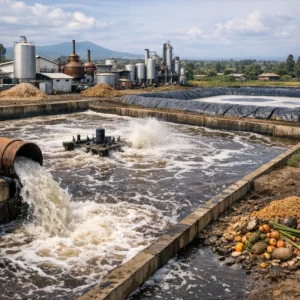
An ETP in Kenya must be designed for the specific wastewater profile of the industry. There is no universal design.
Typical ETP process flow
Most compliant systems include:
- Screening and equalisation
- Chemical or biological treatment
- Clarification and filtration
- Sludge handling and disposal
Industry-specific considerations
- Food factories require strong biological treatment
- Chemical plants need pH control and neutralisation
- Metal industries require heavy metal removal
Oversized or undersized ETPs both fail in practice.
STP in Kenya: Requirements for Domestic and Mixed Wastewater
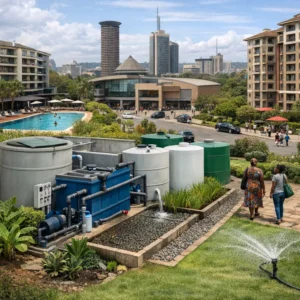
An STP in Kenya must handle variable loads and maintain biological stability.
Common STP technologies
- Activated sludge systems
- Moving Bed Biofilm Reactors (MBBR)
- Sequencing Batch Reactors (SBR)
What regulators now expect
- Stable effluent quality year-round
- Proper sludge wasting and drying
- Odour control and safe reuse or discharge
Hotels and hospitals are frequently cited for poor STP operations, not lack of equipment.
CETP vs Individual Treatment Systems
For industrial parks, a Common Effluent Treatment Plant (CETP) may be an option.
Comparison of options
| Aspect | Individual ETP/STP | CETP |
| Control | Full site control | Shared responsibility |
| Compliance risk | Direct | Collective |
| Capital cost | Higher per site | Shared |
| Enforcement | Straightforward | Complex |
CETPs require strong governance to remain compliant.
Monitoring and Reporting Obligations
Monitoring is no longer optional or occasional.
Required monitoring practices
- Routine effluent sampling
- Accredited laboratory analysis
- Logbooks for daily operation
- Immediate reporting of exceedances
Automation and online monitoring
Larger facilities are encouraged to adopt:
- Flow meters
- Online pH and COD sensors
- Data logging systems
This is where automation becomes a compliance tool, not a luxury.
Operations and Maintenance Under the New Rules
Even the best-designed plant fails without proper O&M.
What inspectors now ask
- Who operates the plant?
- Are SOPs available on site?
- Is sludge disposal documented?
Operation and maintenance is now a compliance pillar, equal to design.
Compliance Checklist for 2024 Regulations
Use this checklist to assess your current status.
| Item | Compliant | Action Needed |
| Valid NEMA licence | ⬜ | Renew or apply |
| Functional ETP/STP | ⬜ | Upgrade or repair |
| Effluent meets standards | ⬜ | Optimise treatment |
| Monitoring records | ⬜ | Implement logs |
| Trained operator | ⬜ | Train or outsource |
| Sludge disposal plan | ⬜ | Formalise contracts |
If you tick less than five, you are at risk.
Penalties and Enforcement Reality
Non-compliance now carries real consequences:
- Licence suspension
- Mandatory system upgrades
- Financial penalties
- Operational shutdowns
Enforcement is increasingly data-driven and less negotiable.
Preparing for Watertech Kenya 2026
Watertech Kenya 2026 – Water Technology Trade Exhibition will be more than a showcase. It will be a compliance benchmark.
Why it matters
- Regulators attend
- Clients ask questions
- Solutions are compared publicly
Facilities without compliant ETP/STP systems, monitoring, and documentation will stand out — negatively.
Practical Compliance Roadmap for Kenyan Facilities
A realistic approach includes:
- Wastewater audit
- Treatment system assessment
- Licence alignment
- Monitoring setup
- Operator training
This is how wastewater compliance in Kenya is achieved sustainably.
Why Experience Matters in Wastewater Compliance
Regulations are written in legal language. Compliance happens on the ground.
An experienced wastewater partner understands:
- Kenyan regulatory expectations
- Local wastewater characteristics
- Practical operation challenges
Compliance is not theory — it is daily practice.
🌊 Ensure Kenya Water Quality Regulations 2024 Compliance Now! ⚖️
Industries: Upgrade your ETP/STP, secure Effluent Discharge Licence, and ace the Compliance Checklist with Arny Mecogreen’s expert wastewater solutions!
📍 Pune, India HQ: Arnym Eco Green Pvt. Ltd. Eleven West Tower, Level 2, Pan Card Club Road, Baner, Pune, Maharashtra 411045 India
Other: +91 20 67872229 | +91 85305 55605
Connect on Social:
📘 LinkedIn